Georgia's stream and river buffers: fifty years of law. County, state, and federal enforcement: an abject failure.
Every trout stream in Georgia carries a mandatory 50-foot undisturbed buffer, every state water at least 25 feet, and the Clean Water Act stands behind both — on paper. In practice, county issuing authorities look away, the State closes verified violations with nothing, and the federal backstop never engages. We are property owners and river people working to change that.
Disclaimer. Georgia Stream & River Buffer Watch is an independent, citizen-run effort, run by Sherman Hawkins, a Gilmer County property owner. It is not affiliated with, authorized by, or endorsed by the Georgia Department of Natural Resources, the Environmental Protection Division, the Georgia Soil & Water Conservation Commission, the U.S. EPA, or any government agency, county, or property owners association. Statements of fact are based on the cited statutes and public records; statements of opinion are the views of the site's citizen authors. This is general information, not legal advice. Corrections are welcome and will be posted.
The law could not be clearer
The Georgia Erosion and Sedimentation Act of 1975 (O.C.G.A. § 12-7-6) commands that “no land-disturbing activities shall be conducted within a buffer” and that a buffer “shall remain in its natural, undisturbed state of vegetation.” That means a 50-foot undisturbed buffer on every designated trout stream and 25 feet on all other state waters, with exactly one lawful exception: a formal variance issued through a public-notice process. The State even posts it on highway signs: “THERE IS A REQUIRED 50 FOOT UNDISTURBED BUFFER ALONG ANY STATE WATERS CLASSIFIED AS TROUT STREAMS.” Buffers are not decoration — the canopy keeps trout water cold, the roots hold the banks, and the ground cover filters what runs off the land before it reaches the stream.
The State's own records show the failure
3,746verified buffer violations in Georgia EPD's own Complaint Tracking System database, 1998–2025
37%of those — 1,386 cases — received no corrective action, no restoration, and no best-management practices. Nothing.
$262the fine in one executed consent order that let structures remain in a trout-stream buffer. No restoration required.
100 sq ftthe “allowance” applied in the field — a number that appears in no statute and comes from guidance never adopted as law
These are not our numbers. They are EPD's — from its own public complaint database and from records any citizen can obtain under the Georgia Open Records Act. In more than one case out of three, the agency's own files show a verified violation followed by nothing. And when the agency does act, its tool of choice is the “pay-and-stay” consent order: a modest fine, some grass seed, and the deck or fire pit or retaining wall stays in the buffer forever. A prohibition that is never enforced is not a law. It is a suggestion.
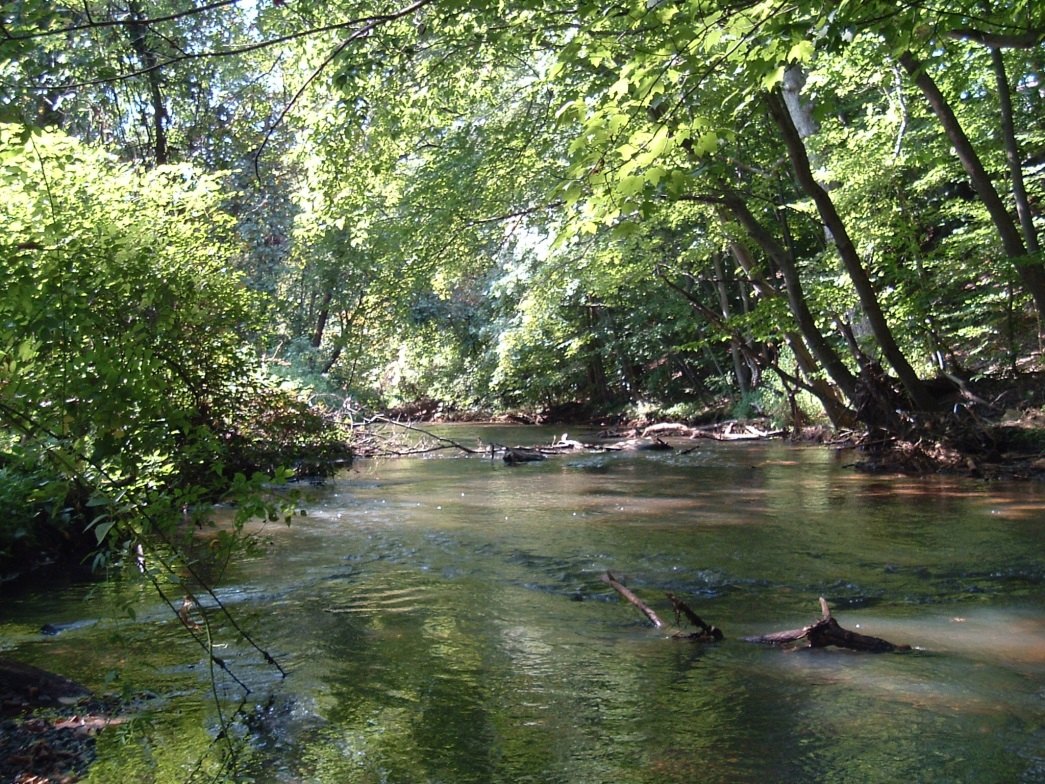
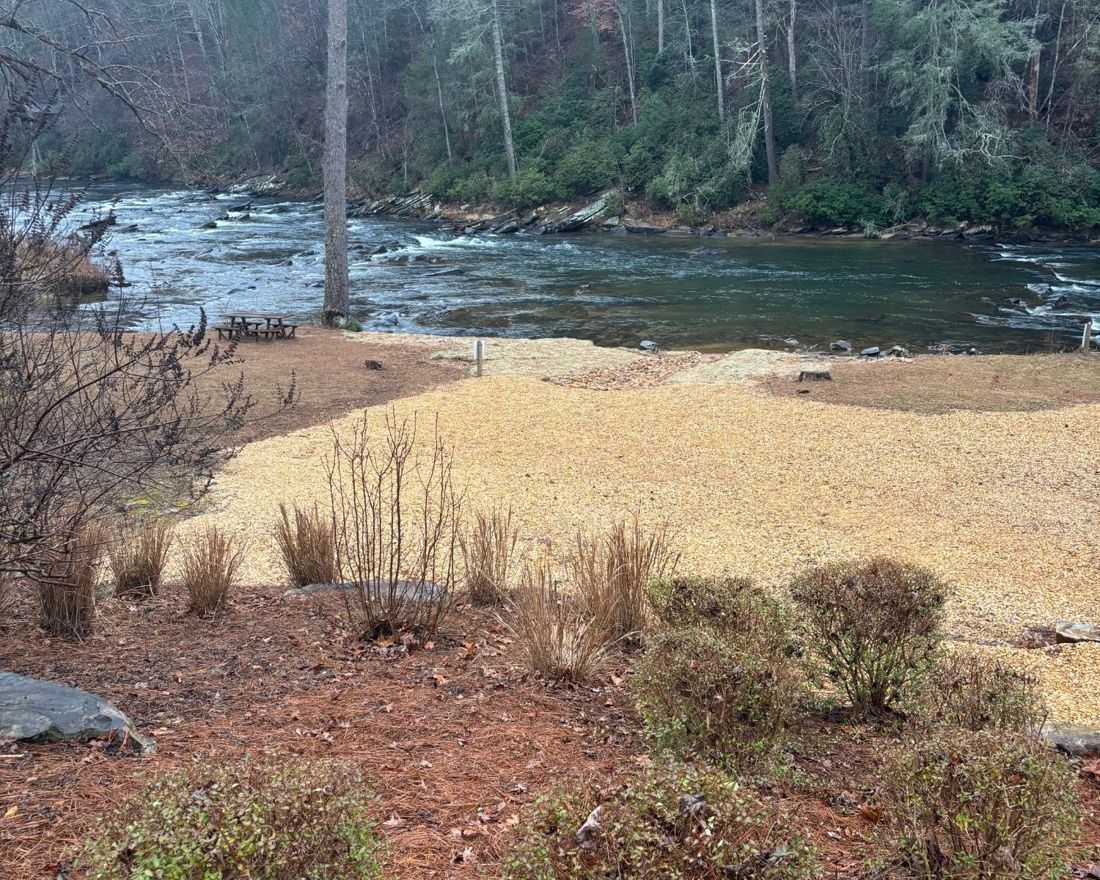
Undisturbed — what the law requires. Full canopy shading the water, roots holding the banks, natural cover to the edge. From the State's own GSWCC Level 1A erosion-control training materials.Disturbed — what a violation looks like. A north Georgia riverbank cleared and graveled to the water's edge. No enforcement action required restoration.
Photos: Georgia Soil & Water Conservation Commission Level 1A training materials (header and left); citizen documentation, north Georgia (right).
How “undisturbed” dissolved into a negotiation
The legislature never changed the statute. The agency changed the paperwork.
2006 — EPD's own procedures require two things when a buffer violation is confirmed: a penalty, and restoration. No discretion.
2009 — State guidance says flatly that the minor-activities permitting exemption “does not provide an exemption from buffer requirements.”
2017 — A guidance memo appears authorizing decks, patios, fire pits, and rip rap in the buffer under 100 square feet. EPD has confirmed in writing it was never adopted through the Administrative Procedure Act — it has no force of law. It is applied in the field anyway.
2024 — An internal draft protocol, which EPD's own legal office concedes “has not been finalized,” converts the duty to restore into a discretionary question: whether a “structural impact is allowed to remain.”
Four documents. Eighteen years. A mandatory prohibition unwound into a negotiation — without one word of O.C.G.A. § 12-7-6 changing.
What we're fighting for
Enforce the statute as written. “Undisturbed” means undisturbed. Where a violation is confirmed, the remedy is removal and restoration — not a fine and a shrug.
Withdraw the 2017 guidance. An agency memo never adopted through rulemaking cannot rewrite a statute. The 100-square-foot “allowance” has no basis in Georgia law.
End pay-and-stay consent orders. The only lawful path to keep an encroachment in a buffer is the public-notice variance process the legislature created — not a private deal.
Publish the records. EPD should post its executed erosion-act consent orders in its public enforcement database, so citizens don't need an Open Records request to learn what was quietly permitted on their stream.
Join the fight
Signatures move legislators. Numbers move agencies. If you own property on a Georgia stream — or just fish one, paddle one, or drink from one — add your name. We'll send occasional updates: what we've found in the records, what to report, and when your voice can make a difference at the county commission, the Capitol, or EPA. No spam, and your information is never shared.
See a buffer violation? Report it — at all three levels
Document it immediately. Photos of the disturbance and the stream, the date, and the location. Pictures taken before a site gets cleaned up are the evidence that matters most.
Your county's Local Issuing Authority (usually planning & zoning) — ask whether a land-disturbance permit or buffer variance exists. These are public records under the Georgia Open Records Act. (Gilmer County Planning & Zoning: (706) 635-3406.)
Georgia EPD — call your EPD district office (Mountain District, Cartersville: (770) 387-4900) or email AskEPD@dnr.ga.gov with your photos, location, and dates — and ask that a complaint number be assigned in EPD's Complaint Tracking System so you can follow what happens.
Federal, when the water itself is disturbed — fill, equipment, or structures in the channel are Clean Water Act territory: report to U.S. EPA and ask whether Section 404 (Army Corps) and Section 401 (EPD) authorizations exist.
Log your report with Buffer Watch
Agencies lose complaints. We don't. File your report here as well and we'll log it, give it a Buffer Watch tracking number, and post it (with your name withheld) on the public Violation Log — including the CTS number once EPD assigns one, and how long that took. A complaint on a public log is much harder to ignore.